
FYI: we may earn a commission for qualified purchases made through the links in our articles (learn more).
Quick Summary
- Typically, your dog won’t need help when she is giving birth. It is best not to disturb her during the process and only monitor her for possible problems—in which case, take her to the veterinarian immediately.
- Signs your dog is in labor: whining and whimpering, vomiting, restlessness, pacing, panting, or shivering, lack of appetite, and working instinctually at building a nest.
- The best thing you can do for a dog giving birth is to make her environment as comfortable and as calming as possible.
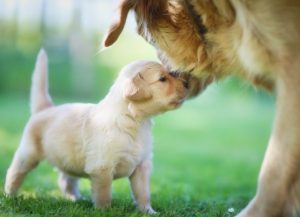
Dogs are amazing creatures and giving birth is a miraculous process. If you have ever wondered how to help a dog give birth, you have come to the right place. I will provide a step-by-step guide on how to help a dog give birth. Though here at Good Pup Life we strongly advocate spaying or neutering your pets. I understand that from time to time accidental pregnancies do occur. I have also heard countless stories of rescued animals found pregnant or on the verge of giving birth. For that reason, I want to make the necessary information for helping a female dog give birth available to all pet parents. With the proper information, pet parents can avoid any unnecessary complications. That could harm both the mother and offspring, and help deliver a healthy litter of puppies.
How long is dog pregnancy
A dog’s pregnancy from conception until birth lasts about 63 days (about two months, give or take a few days). Determining whether or not your dog is pregnant is a tricky business. If you have some idea of the date of conception, do your best to keep track of that date to help you along. Besides the eventual belly bump, the best way to determine whether or not your dog is pregnant is to take her in to see a veterinarian that can perform an ultrasound around the 25th day of pregnancy.
“After 25 days, the embryonic heart may be seen beating, but it is more difficult to count the number of pups using this method. A general pregnancy blood test can be performed around day 35 just to confirm whether or not she is pregnant but neither this nor ultrasound will tell you how many puppies to expect; only radiographs can do that,” says the Mar Vista Animal Medical Center. A radiograph can be performed around day 45, at which point “the skeletons of the unborn pups will have mineralized and are thus visible on a radiograph.” With this procedure your veterinarian should be able to tell you how many puppies to expect so that you’re well prepared for the big day.
Dog pregnancy care
Halfway through the pregnancy, you’ll see an increase in the mother’s appetite. Normally she would need to eat about twice as much as she used to, and more when the puppies arrive and she is producing milk—her food consumption then should be about three times more than before her pregnancy. The pregnant mother’s exercise regime should continue as normal until about four to six weeks into the pregnancy, at which point more extreme and intense activities/exercise should be restricted to a comfortable level for the mother. Also, though vitamins and supplements are essential parts of any diet for a dog. During pregnancy, a dog should be taken off of any vitamins or supplementation (particularly calcium) to avoid harm to the newborn pup.
As previously explained, your pregnant dog will deliver at or around 63 days. Small breed dogs may deliver as much as a week earlier, while larger breeds may deliver up to a week later. It’s important to isolate your dog from other dogs about three weeks before labor begins and until about three weeks after the delivery of the puppies. Restricting your dog’s access to other dogs will prevent the spread of herpes. A fatal disease for unborn or newborn puppies, though adult dogs may not show symptoms.
Whelping box
You may create a safe space for her that includes a whelping box or a big open crate, lined with towels or newspaper that’s a comfortable area where she can give birth to her puppies. Determining the big day doesn’t have to be a hazy journey. Your number one tool in determining your dog’s pregnancy is her temperature. Starting at about two weeks prior to what you think her due date may be, begin to take her temperature rectally. Her normal temperature should lie somewhere between 101° and 102.5° Fahrenheit. As soon as the mother-to-be’s temperature drops to below 100°F expect that you’ll have some newborn pups arriving within 24 hours.
How to help a dog give birth at home:
Stage One (First stage)
The process of giving birth for your dog comes in two stages, with a third stage occurring following the pups’ birth. Although you may find the thought of helping your dog deliver puppies daunting, don’t fret because experts say over 98 percent of dogs that deliver puppies do so without assistance or complications.
During stage one of labor, after your dog’s temperature has fallen below 100°F, your dog will start to feel contractions, and like human births, the cervix will begin to dilate. Also, like human labor, the contractions are very painful and extremely uncomfortable for your dog. Contractions can last anywhere from six to eighteen hours until full dilation of the cervix occurs.
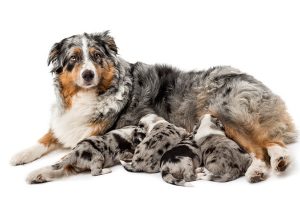
During this time you may notice any or all of the following signs of dog labor. All of which are perfectly normal: First stage
 Whining and whimpering Vomiting Restlessness Pacing, panting, or shivering Lack of appetite Working instinctually at building a nest
What you can do to help pregnant dogs
As the pet parent, do your best to make your dog’s environment as comfortable and as calming as possible. Keep her sequestered to a safe space and be supportive and encouraging in your attitude. Though your dog may not understand your words, she will definitely understand your state of mind. If you are frantic it will make things more difficult for her. So try to maintain your cool and keep her calm.
It is important to note that if your dog does not go into labor within the 24 hours since the drop in her temperature, she should immediately be taken to the veterinarian. Similarly, if your dog’s pregnancy goes beyond 69 days, something may be wrong and your dog should see a vet. She may need a C-section to help her deliver her puppies.
Stage Two
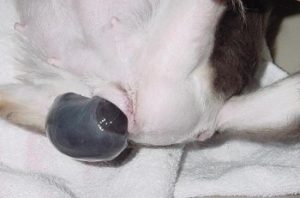
In veterinary medicine, the second stage is referred to as “hard labor,” which is when the mother dog’s puppies make their way through the birth canal. The contractions will be at their strongest at this point as your dog does her best to push the first puppy out and so on.
A dog’s placentas are expelled either after each puppy comes out or just randomly. Every puppy develops inside of the mother in its own individual amniotic sac. When they are born, the puppies are born still in that sac. It’s important to know that every pup won’t necessarily be followed by afterbirth. It’s possible for the mother dog to expel two puppies, one after the other, and then two placentas.
Pregnant Dog Complications (When to call the vet)
If you are aware of the number of puppies to be born, you can expect each to come at 45-60 minute intervals, with intercessions of 10-30 minutes of pushing on the mother’s part. Though this is the case, it’s still normal for the mother dog to take a break of up to four hours before resuming the birthing process. However, all lengths of time during this process are very precarious. If your dog fails to resume pushing after four hours, or if she strains to push a puppy out for more than an hour, a veterinarian should be consulted without delay.
It’s normal for puppies to be born tail first; in fact, about half may be born in this way. If for some reason you see a puppy’s rear legs sticking out of the mother’s vagina and it’s been more than 15-30 minutes, experts say that you may try to help her by very gently pulling the puppy. Do this in a downward and rearward arcing motion. If you do not feel completely comfortable doing this, or if there are complications that seem beyond your capabilities, it’s always best to consult a veterinarian.
Things you can do for newborn puppies
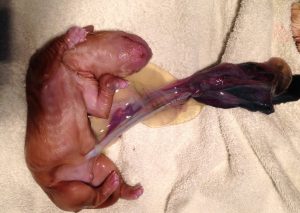
When each puppy is born, the mother will break open the amniotic sac, bite off her pup’s umbilical cord, clean the puppy profusely with her tongue to ensure proper breathing and circulation, and may even eat the afterbirth. It’s incredibly important that your dog does this as it’s the way in which a mother dog forms a bond with each puppy. If for some reason your dog refuses to do this after about 10-15 minutes. You should gently break open the amniotic sac, tie the umbilical cord about one inch from the belly in a knot or with dental floss, and cut the cord. You should then rub each puppy vigorously with a warm towel to stimulate breathing and circulation.
After all puppies have been whelped, stage three kicks in. As most vets explain, the uterus will fully contract and the mother dog will expel all of the remaining placenta, blood and fluid. Expelling all final fluids may last up to eight weeks in small amounts, say the professionals over at Mar Vista Animal Medical Center. At this stage, the mother should be very attentive to her puppies. She should be bright and alert with a large appetite, which will help with her milk production. You can check the mother’s milk flow by the slightest of finger pressure.
As complications may arise at this stage, this is when pet parents should have their eagle eyes open. A mother dog can normally run a low fever in the two days after birth. If that fever reaches heights above 102.8°F then you should be concerned. This, coupled with a lethargic, depressed, or excessively thirsty dog, may be a sign of a retained placenta or puppy. This is one of the reasons why it’s so important to know how many puppies to expect so that you as a pet parent can be ever vigilant.
These complications can also be a sign of a uterine infection, also called metritis. Signs of metritis are as follows:
Signs of metritis
Fever Foul-smelling vaginal discharge Listlessness Loss of appetite No interest in the puppies Decreased milk production
If your dog required assistance during delivery, then she is more susceptible to metritis, so keep an eye out.
Another common postpartum problem that may occur is eclampsia. Also referred to as “milk fever,” eclampsia is a glandular condition where “the parathyroid gland does not secrete sufficient calcium-releasing hormone,” explains Dr. Hines. The calcium demand of lactation on the mother dog is too much to support. Many times this occurs in mother dogs that have been supplemented with calcium. This condition usually appears within three weeks of giving birth.

Signs of eclampsia
According to Mar Vista Animal Medical Center, are as follows:
Nervousness and restlessness No interest in the pups Stiff, painful gait Muscle spasms Inability to stand Fever Seizures
This condition should not be taken lightly, as it is life-threatening. It generally occurs in smaller dog breeds, especially those dogs with large litters. Take your dog to the vet immediately if you suspect she’s suffering from eclampsia. Mother dogs may also suffer from mastitis, or inflammation of the breasts. Note that normal nursing glands for mother dogs are soft and enlarged while diseased glands can be red, hard, and painful.
The mother dog may not behave as if she’s sick because the disease is contained within the mammary tissue. Because this disease causes pain in the breasts, the mother dog might discourage her pups from nursing. Experts say that it’s very important that puppies continue to nurse as this helps to “flush out the infected material.” You may also use hot packs on the breasts to relieve the mother dog’s suffering.
Hypoglycemia and milk failure
Another complication to be aware of is hypoglycemia, or low blood sugar. Signs of hypoglycemia include disorientation, weakness, below normal temperature, and low blood sugar. Any of these conditions can also contribute to early milk failure or not enough milk to wean the puppies. Though this can occur in any mother dog, dogs with eclampsia, mastitis or a systemic disease are more susceptible.

Finding Homes For The Puppies
Now that your mother dog has gone through the process of giving birth, it’s time to give those puppies names and find them homes! The best you can do as a responsible pet parent is try to find good homes for the puppies via friends, family, co-workers, or online resources such as PetFinder.com. Make sure that the family adopting your precious puppy understands the responsibility of owning a dog and that they know “dumping” an animal at a shelter should be the very last resort, but more so not an option at all.
Make sure they’re aware of a dog’s nutritional, medical, and training needs. Refer them to reputable trainers via the Association of Pet Dog Trainers. Make sure they understand that owning a dog is no cheap venture. Lots of money, time, and patience are involving in raising a puppy, nearly as much as with a human child. Discuss the dog’s nutritional options, refer them to your veterinarian, make them aware of the dog’s vaccination needs. Remind them that if all else fails and the match doesn’t work out that you’re available to help re-home the animal.
If all of that feels like a daunting task, contact a local animal rescue with a good reputation willing to take the puppies in or help you find the puppies some homes. If this does not work out, research the animal shelters in your area and make sure that you leave the puppies in a no-kill or low-kill animal shelter. Where they’ll have a good chance of finding good homes and a chance at living a full life. However, this should be the absolutely last resort, and should be unnecessary if the proper steps are taken to ensure homes for your puppies.
FAQs
How can I help my dog push her puppies out?
If your dog can’t push her puppies out, it’s best to get help from a vet. It is not advisable for pet parents to intervene when a dog is giving birth as there could be complications.
Why is my dog not pushing her puppies out?
When the uterus no longer contracts and pushes the puppies through the vaginal canal, it is called uterine inertia or uterine exhaustion. This often happens when a puppy is too large to fit through the birth canal.
How do you know if a puppy is stuck in the birth canal?
A puppy is most likely stuck in the birth canal if the mother dog does not go into labor at the expected time, she is in pain or is uncomfortable, has pale gums, and dark green vaginal discharge.


Leave a Reply